

Gasoline Transportation Ally
Top-Down Survival Refueling Game
2025
A fast-paced top-down survival game where players refuel escaping cars using a custom pressure-sensor controller to keep them from running out of gas and getting caught.
Overview
The goal of this project was to create a unique and immersive interaction system for a simple everyday action—fueling a car. Instead of relying on standard keyboard and mouse input, we designed and built a physical fueling-gun controller connected to an Xbox Adaptive Controller, enabling players to physically simulate the fueling experience.
Development Time: 2 weeks
Team: 5 people (me and four other students at Carnegie Mellon University’s Entertainment Technology Center)
Objective: Build an interface to perform a task
Prompt: Fueling a Car
Task: Using solely the Xbox Adaptive Controller to simulate the experience of fueling cars
My Role: Game Designer, Concept Artist, Animator
My Highlights
-
Initiated the project concept and collaboratively designed the fueling system and core gameplay loop and built around a custom fuel-gun controller, balancing urgency, strategy, and precision.
-
Structured the multi-level progression system, ensuring escalating tension through increasing fuel drain rates, tighter spacing, and more complex lane interactions, adding to the interest curve by shifting scene and level design.
-
Developed the risk–reward refueling mechanic, where overfilling causes chain explosions that redistribute fuel — turning mistakes into dynamic opportunities.
-
Defined the game flow and player feedback systems, including timing cues, visual prompts, and screen layout logic to enhance clarity and rhythm.
-
Determined the game interface and visual direction, creating a clean, readable interface and bold and effective art style that support quick decision-making.
My Role
I took part in concept development and game design, utilizing my previous game jam experience to quickly adapt to the rapid-prototyping workflow. I actively contributed to brainstorming sessions and refining the game’s core mechanics, while also designing the user interface to ensure visual readability and intuitive player feedback.
In addition, I designed the overall visual style of the game and created all the animations (including 2D story sequences and 3D in-game animations), concept art, and textures. We chose a cyberpunk aesthetic not only to align with the game’s narrative tone but also to enhance gameplay readability—using glowing visual cues to highlight interactive elements and naturally guide player attention. Every artistic decision was made with game design clarity and player immersion in mind.
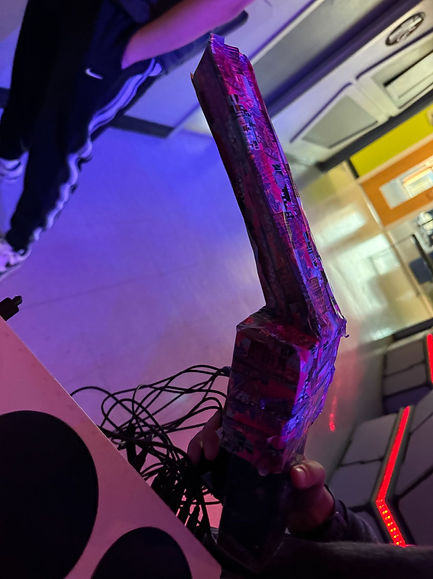
Fuel Gun Controller (Cardboard Prototype)
We built a cardboard prototype of the fueling gun that detects player input through tilt-based movement and button presses.
-
Includes five buttons: forward, backward, left, right, and a trigger for refueling.
-
Internal design features two sliding tracks—one for forward/backward and one for left/right movement.
-
Each track has buttons at both ends (e.g., the front button triggers “move forward,” the back triggers “move backward”).
-
A weight inside the controller shifts when tilted, pressing the corresponding directional buttons.
-
The trigger button is manually pressed to simulate the refueling action.
This physical interface was central to the player experience, making the act of fueling feel tangible and engaging rather than abstract.
Game Cycle & Evolution
Initial Concept: The project began as a top-down arcade survival prototype centered around a custom-built fuel-gun controller. The player’s goal is to assist getaway cars by refueling them before they run out of gas—if a car’s fuel depletes completely, it slows down and gets caught by the pursuing police cars at the bottom of the screen.
Core Loop: Five getaway cars move downward through five survival stages, gradually losing fuel. The player, piloting a flying cat-shaped refueling drone, must strategically decide which car to refuel next while avoiding overfills that can cause explosions.
Mechanics:
-
Each car’s descent speed is tied to its current fuel level—the less fuel it has, the faster it falls toward the bottom.
-
Refueling temporarily halts its descent, pushing it for a distance forward toward the top of the screen.
-
Overfilling causes an explosion that splashes fuel into neighboring lanes, creating a deliberate risk–reward dynamic.
Playtesting
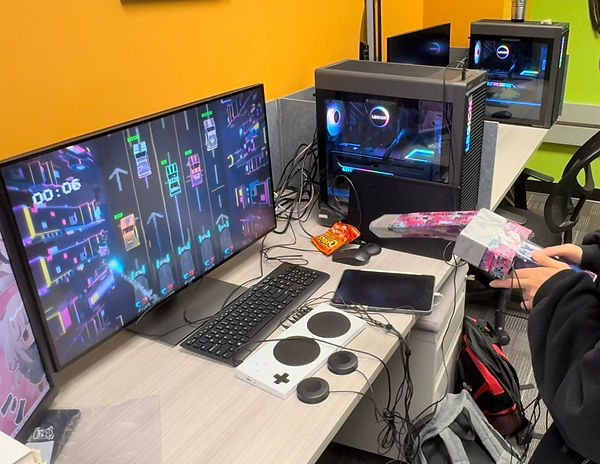
At the end of the first week, we conducted a playtest session with other students using a semi-finished version of the custom fueling-gun controller, which at the time used bullet casings inside the tubes as weights. While the physical controller and cyberpunk art direction drew strong attention, players encountered several issues related to both control and game logic.
Early Build (Interim)
Feedback highlighted two main areas of difficulty — input control and fueling mechanics.
-
Fueling sensitivity: The fueling button was overly pressure-sensitive, making it difficult to manage the right fuel amount. Overfilling cars caused frequent explosions, and many players ended up scoring zero points.
-
Controller stability: The bullet casings inside the controller rattled and sometimes stuck against the Xbox Adaptive Controller buttons, making precise movement difficult.
-
Gameplay clarity: Missing explosion feedback, unclear fuel logic, and lack of onboarding caused confusion, leading to frustration and unclear objectives.
These observations revealed the need for clearer feedback cues, more forgiving progression, and smoother hardware calibration.
Iteration & Refinement
During the second week, we addressed these problems while expanding gameplay content.
-
Control improvements: Replaced bullet casings with single balanced weights for smoother tilt detection, and removed pressure sensitivity to create a continuous fueling process closer to real-world behavior.
-
System redesign: Rebuilt the gasoline system with distinct color indicators and audio feedback, improving clarity and response.
-
Player onboarding: Added a short tutorial sequence and dialogue-based introduction, letting players fuel one car before scaling to all five.
-
Interface updates: Integrated timer and scoring UI to establish pacing and a clearer sense of progress.
Final Build
These refinements produced a more balanced rhythm, where players could plan refueling cycles and read on-screen feedback intuitively. The improved visual cues and difficulty tuning made the experience both more engaging and accessible.
Remaining issues included an “optimal” mid-lane strategy, a plateau in late-game challenge, and limited escalation in the final minute — insights that would guide future iterations.
Final Goal: Survive the countdown with at least one car remaining — a test of focus, timing, and resource management under pressure.